
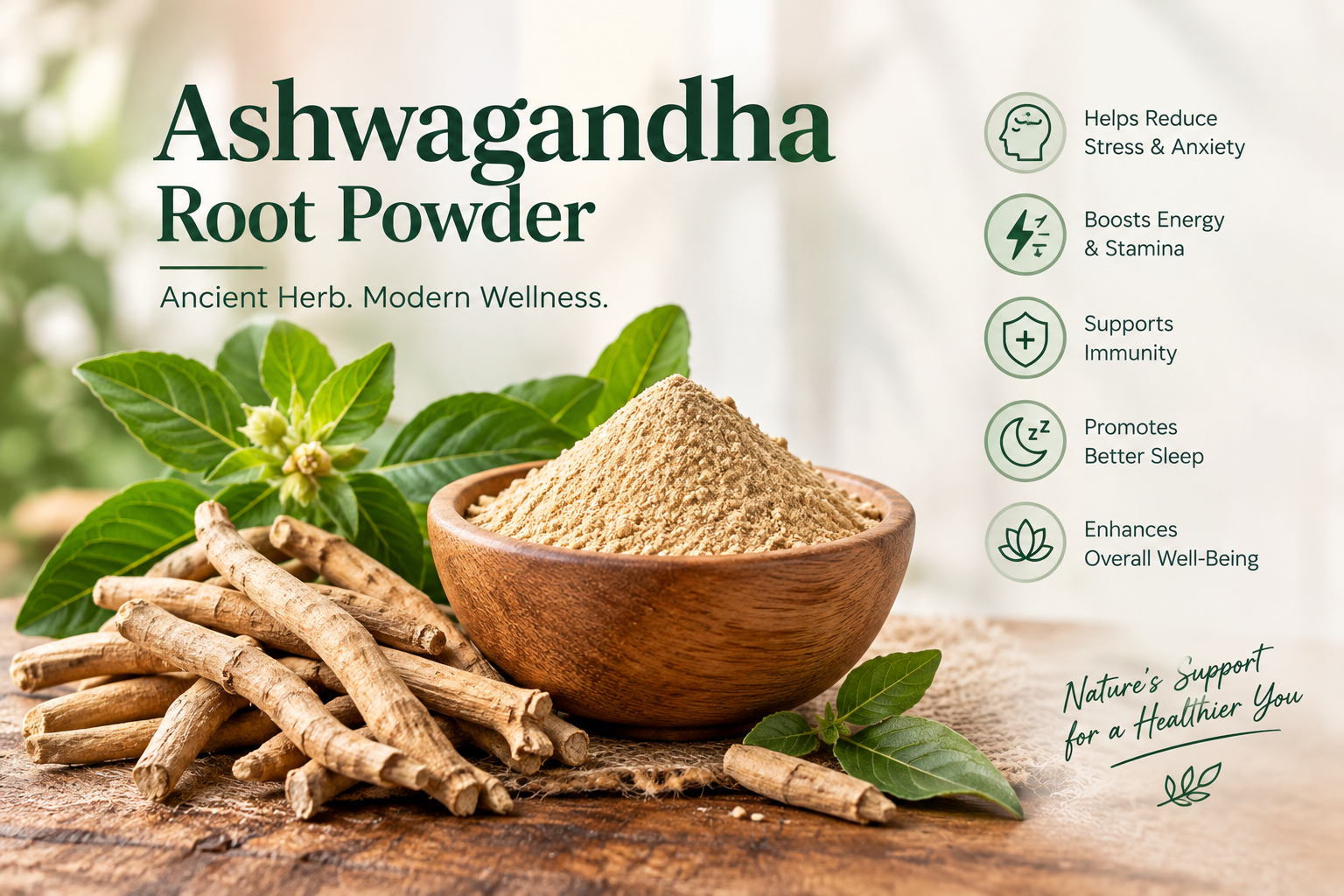
Ashwagandha is now one of the most popular Ayurvedic herbs in India. It is also increasingly used in wellness products, herbal formulations, nutritional products, and traditional preparations. Among the plants used in Ayurveda for a long time, the roots of Withania somnifera have been used extensively. Research today has looked at different preparations of ashwagandha for a variety of things, from stress to sleep, with the strength of the evidence depending on the preparation and use.
Nowadays, there are so many products available in India that it can be challenging to find the best ashwagandha root powder. Different suppliers may have different sourcing practices, processing methods, specifications, certifications, and quality-control standards for their products.
If you are buying ashwagandha for personal use or in bulk for an herbal, wellness, food, or Ayurvedic business, knowing what constitutes a quality product can help you make a more informed decision.
What Is Ashwagandha Root Powder?
Ashwagandha is an evergreen shrub used in traditional Ayurvedic medicine. Its botanical name is Withania somnifera, with the root being one of the major plant parts used in traditional preparations.
The root contains withanolides, which are naturally occurring compounds, along with other phytochemicals. But the concentration of these substances may differ depending on such things as plant variety, cultivation conditions, harvest, processing, and whether the product is whole root powder or a concentrated extract.
Ashwagandha root powder is usually made by washing the roots, drying them in the sun, and then grinding them into a fine powder.
So the first step for buyers looking for the best ashwagandha root powder in India is to know exactly what they are buying.
Why Does Ashwagandha Root Quality Matter?
The quality of a botanical powder starts with the raw material. Poor quality roots, improper drying, unsuitable storage, or inadequate testing can affect the final product.
A high-quality ashwagandha powder has well-defined specifications and appropriate quality control procedures.
Important quality factors are
• Correct identification of the plant
• Root raw material only
• Good practices for cultivation
• Correct harvesting
• Drying controlled
• Constant grinding
• Proper storage
• Lab tests
• Proper packaging
• Traceability of lots
Price should not be the sole deciding factor in comparisons between suppliers.
1. Check out the botanical name.
Botanical identity is one of the first things to check.
The product must be clearly identified as Withania somnifera. Botanical identification helps to ensure that you are getting the intended plant versus a misidentified or substituted material.
If you are buying commercially, ask the supplier for product specifications or identity-testing information where appropriate.
This is particularly important when comparing multiple vendors who claim to be the best source of ashwagandha root powder in India.
2. Ensure It Has Root
This is one of the most important things to look at.
In an advisory issued in April 2026, the Food Safety and Standards Authority of India (FSSAI) clarified that only Ashwagandha roots and their extracts are allowed, and Ashwagandha leaves are not permitted in those products in the specified food and health-product categories covered under the relevant regulations.
The buyer should therefore carefully check the ingredient declaration and product specifications.
If you specifically want root powder, look for a product clearly identified as ashwagandha root powder, rather than a product containing unspecified plant parts.
3. Whole Root Powder vs. Extract—Know the Difference
Another important consideration is whether you are buying whole-root powder or an extract.
The root is dried and ground to make whole root powder. The extract is then processed further to concentrate certain components.
The products should not be considered equivalent per se.
If a supplier claims a certain percentage of withanolides, ask if it is a standardized extract or just plain root powder and request documentation if appropriate.
For many traditional applications, buyers looking specifically for whole-root material should ensure they aren't confusing it with a concentrated extract.
4. Source and Cultivation Practices
The quality of the best ashwagandha root powder in India begins with the quality of the roots.
Inquire with suppliers about where their ashwagandha is grown and whether they have existing sourcing relationships with farmers or whether they control the growing and purchasing process.
Helpful questions include
• Where is Ashwagandha grown?
• How are the practices carried out?
• How do you collect the roots?
• What is the transport of roots?
• What is the time from harvest to processing?
* Is the supply traceable?
The supplier must be able to explain in a clear way how it sources its products.
5. Look at the Processing and Drying Method.
Drying is an important step in the processing of botanicals.
Fresh roots are cleaned and dried under controlled conditions, then made into powder. Product instability can result from incorrect drying or from excess moisture.
Inquire from the supplier about:
• Cleaning procedures
• Condition of drying
• Managing moisture
Technologies for Grinding
• Size of particle
• Hygiene of process
• Storage conditions
Consistent processing can help manufacturers to make more consistent batches.
6. Laboratory Testing Check
Responsible botanical sourcing includes laboratory testing.
Testing depends on the intended use and regulatory requirements and may include parameters such as:
• Microbiological quality
• Water
• Heavy metals
• Residues of pesticides
• Foreign objects
• Identity.
• Other pertinent contaminants
If intended for commercial use, request a Certificate of Analysis (COA) where appropriate.
A COA can provide batch-specific data, making it simpler to compare suppliers using measurable specifications rather than marketing claims.
7. Check Certifications
Certifications can give you more insight into the supplier’s production and quality systems.
If a product is labeled as organic, consumers should look for the appropriate organic certification, not just the word “organic.”
In India, under the organic-food framework, the FSSAI recognizes two organic certification systems: the Participatory Guarantee System (PGS) and the National Program for Organic Production (NPOP).
Jaivik Bharat consumer guidance also states that certified organic products should carry relevant certification and labeling information.
Commercial buyers need to verify that a certificate is current and actually applies to the product and facility being offered.
8. Assess Color, Aroma, and Texture
You can also use physical characteristics to help evaluate a sample.
Properly processed root material should show characteristics consistent with high-quality Ashwagandha root powder. But appearance alone does not guarantee purity or safety.
Compare samples when you think:
• The color
• Scenting
• Coherence
• Particle size
• Foreign material present
• Vlažnost
• Taste (if applicable to the intended use)
Visual inspection cannot detect every quality issue, so when appropriate, laboratory testing should still be performed.
9. Consider packing and storage
To retain quality, herbal powders need to be packed properly.
Ashwagandha powder will be protected from moisture, contamination, excess heat, and improper storage conditions.
Check that the packaging includes:
• Name of Product
• Scientific name
• Details of ingredients
• Batch/Lot number
• Production details
• Expiry or best before information
• Storage instructions
• Details of the manufacturer
• Certification information, if applicable
When purchasing in bulk, packaging should also be suitable for transport and storage over a longer time.
10. Compare Suppliers on Quality, Not Just Price
When looking for the best ashwagandha root powder in India, you may be tempted to choose the cheapest vendor.
But price itself doesn’t tell you if the product has been properly sourced, processed, tested, and packaged.
Instead, compare suppliers on:
- Factor: What to Look For
- Botanical Name: Withania somnifera
- Root part: Root
- Processing: Cleaning, drying, and milling
- Testing: Relevant laboratory parameters
- Documentation: Product specifications and COA
- Certification Certifications associated
- Packaging: Protection against moisture and contamination
- Traceability: batch/source details
- Supply Capacity and Consistency
- Price: cost versus specifications
A higher price can be justified if the supplier provides higher quality assurance, documentation, consistency, and reliable supply.
11. Order a Sample Before You Buy in Bulk
If you’re purchasing ashwagandha powder commercially, get a sample prior to placing a bulk order.
A sample allows you to judge the product and to compare with other suppliers.
It’s useful for businesses to compare:
Looked
• Smell
• Coherence
• Size of particles
• Laboratory requirements
• Package
• Documentation.
• Batch uniformity
If the supplier does not have enough information about the product or is unwilling to explain the specifications, take this as a reason to dig deeper.
12. Verify Supplier Experience and Production Capacity
A good supplier should be able to maintain consistent quality as order volumes increase.
This is particularly crucial for companies that need a consistent supply of Ashwagandha powder.
Request for:
• Minimum order quantity
* Monthly production capacity
• Delivery time
• Wholesale Packages
• Private label options
•Export documentation (if applicable)
• Consistent order of repeats
• Customer support
An experienced supplier can be a better long-term partner than a supplier who just offers a low initial quote.
Possible Uses of Ashwagandha Root Powder
Ashwagandha is a botanical traditionally used in Ayurvedic preparations and is now an ingredient in many different wellness products.
Recent research has examined some ashwagandha preparations and stress and sleep. NCCIH says some preparations may help with insomnia and stress, but the evidence is unclear for several other uses they claim to help with.
Ashwagandha root powder can be used as an ingredient in:
• Conventional Ayurvedic medicines
• Herbal preparations
• Products for wellness
• Functional food products
• Herbal drinks
• Nutritional formulations
Proper use is dependent on product specifications, intended application and applicable regulations.
Safety Considerations to Keep in Mind Before Buying Ashwagandha
It is important to choose a quality product, but it is equally important to use it responsibly.
NCCIH says short-term use of some Ashwagandha preparations may be safe for some adults, but long-term safety is not well established. Side effects reported include drowsiness and gastrointestinal symptoms, with rare cases of liver injury reported.
Ashwagandha should not be taken during pregnancy and is not recommended during lactation. If you have thyroid or autoimmune conditions, are preparing for surgery, or are taking certain medicines, consult a healthcare professional before using it.
Natural products can also interact with medicines, so it’s especially important to seek professional advice if you are taking a prescription drug or have a pre-existing medical condition.
Why Pick an Indian Ashwagandha Supplier?
India is an important source of raw materials and products of Ashwagandha, and the country has a long history of cultivation and Ayurvedic use of Ashwagandha.
But being made in India alone does not guarantee quality.
Here are some points to keep in mind when selecting the best ashwagandha root powder in India: Transparency in sourcing, correct botanical identity, root-specific specifications, processing, testing, documentation, and consistent supply.
If you’re looking for botanical ingredients for your business, consider Husband Wife Farm in your supplier-evaluation process. All product specifications, testing documentation, packaging, certification status, and intended use are the responsibility of the buyer to verify prior to placing an order.
Summary:
Selecting the best ashwagandha root powder in India is more than simply comparing prices or choosing a popular product.
First, look at the botanical name, plant part, sourcing, processing, testing, certifications, packaging, and supplier transparency. If you’re buying for commercial use, request samples and batch-specific paperwork before ordering larger quantities.
Also, it is important to make a distinction between traditional uses and scientifically proven benefits. Some Ashwagandha preparations may have potential for areas such as stress and sleep, but evidence varies between preparations.
If you're a buyer looking for a reliable botanical ingredient, the best supplier is one that can show consistent quality from the sourcing of the raw material, through processing, testing, packaging, and delivery.
A thorough assessment will enable you to find an Ashwagandha root powder that fits your standards and is suitable for the intended use.
Frequently Asked Questions?
1. What to look for in the best ashwagandha root powder in India?
A. Look for Withania somnifera root, clear sourcing, proper processing, lab testing, batch documentation, adequate packaging, and verified certifications where applicable. The plant part of the product should be clearly identified as root."
2. Is Ashwagandha root powder equal to Ashwagandha extract?
A. Yes. Root powder is usually simply the dried and ground root. An extract has been further processed to concentrate selected constituents. The two products may therefore have different compositions and should not be considered equivalent in themselves.
3. How can I tell the quality of ashwagandha root powder?
A. Request product specifications, relevant laboratory testing, and a Certificate of Analysis where appropriate from the supplier. You can also check botanical identity, plant parts, sourcing information, processing methods, and batch and packaging details.
4. Is the organic ashwagandha root powder the best?
A. Organic certification means that the product was produced in compliance with the applicable organic standards. It does not, by itself, guarantee all aspects of product quality. Check the relevant certification and testing, sourcing, processing, and batch consistency. FSSAI NPOP & PGS certification systems recognize India’s organic foods.
5. The following are the benefits of Ashwagandha most researched:
A. Research has looked at ashwagandha preparations for stress, sleep, and many other areas. NCCIH says some preparations might help with stress and insomnia, but evidence is insufficient or unclear for many other advertized uses.
6. Is Ashwagandha root powder safe for all?
A. No. Ashwagandha may cause side effects and may interact with drugs. It should not be used in pregnancy and is not recommended during breastfeeding. It’s worth noting that those with thyroid or autoimmune disorders, those preparing for surgery, and individuals on certain medications should seek medical advice before using it.