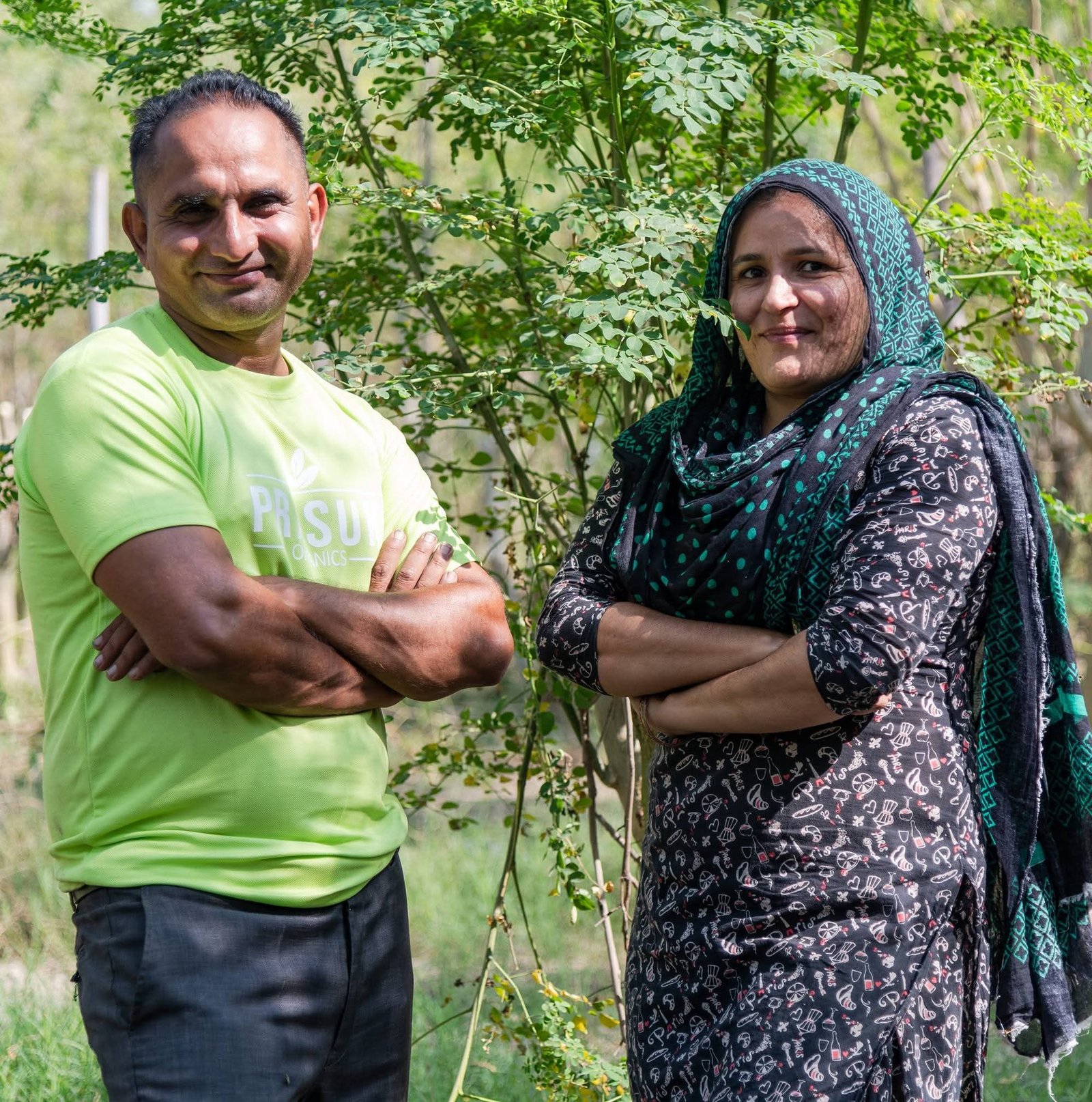

How Moringa Leaves Are Washed, Dried and Made Into Powder
Moringa powder may look simple when it reaches your kitchen, but producing a good-quality powder involves several careful steps before the leaves are finally packed.
The journey begins with fresh Moringa leaves on the farm.
From harvesting and initial cleaning to thorough washing, drying, pulverizing and packing, every stage matters.
At Husband Wife Farm, we believe that customers should know what happens to their Moringa before it becomes the green powder inside the packet.
Our basic process is:
Harvesting → Cleaning → Thorough Washing → Drying → Pulverizing → Powder Collection → Packing
In this guide, we take you through our farm-to-powder Moringa processing journey and explain why each stage is important.
Step 1: Harvesting Fresh Moringa Leaves
The journey starts with fresh Moringa leaves.
Moringa is a fast-growing plant, and its leaves are harvested from healthy plants for processing.
Once harvested, the leaves are brought for cleaning and processing.
The objective is to handle the fresh leaves carefully so they can move through the processing stages in good condition.
Step 2: Initial Cleaning
Freshly harvested Moringa leaves can contain natural field material such as:
- Soil particles
- Dust
- Small pieces of plant material
- Unwanted leaves or stems
- Other field debris
Before washing, the leaves are inspected and cleaned to remove unwanted material.
This is the first step toward preparing the leaves for thorough washing.
Step 3: Thorough Washing of Moringa Leaves
After initial cleaning, the Moringa leaves are thoroughly washed.
At Husband Wife Farm, we have dedicated washing tanks for cleaning herbs before they move toward drying.
Washing is an important step because Moringa is an agricultural product that comes directly from the farm environment.
The purpose of washing is to help remove unwanted surface material such as soil, dust and field debris.
Our approach is:
Harvest → Clean → Thoroughly Wash → Dry
We do not consider washing an optional step.
Why Do We Wash Moringa Before Drying?
Drying and washing have completely different purposes.
Washing helps clean the leaves.
Drying helps reduce moisture.
Simply drying a leaf does not remove soil or dust from its surface.
This is why the leaves are washed before they enter the drying stage.
Once the leaves are eventually ground into a fine powder, any unwanted material remaining on the raw material would be carried into the finished product.
Good processing therefore begins with appropriately cleaned raw material.
Step 4: Preparing the Washed Leaves for Drying
After washing, the leaves contain surface water.
Before drying, they are handled appropriately so that excess water can drain away and the leaves can be prepared for the drying stage.
This transition is important because the objective is to move from:
Thoroughly Washed Leaves → Appropriately Prepared Leaves → Dried Moringa
Step 5: Drying the Moringa Leaves
Drying is one of the most important stages in making Moringa powder.
Fresh Moringa leaves contain considerable moisture and cannot simply be pulverized directly into a stable powder.
The leaves first need to be dried appropriately.
At Husband Wife Farm, we use a covered solar drying setup as well as an electric drying system.
Our Covered Solar Dryer
Our solar drying setup has an approximate covered area of 240 square metres and a height of around 20 feet.
The covered environment provides a dedicated space for drying the leaves instead of simply spreading them outdoors under direct sunlight.
Our solar drying setup also uses fans to circulate air within the drying area.
The objective is to create suitable drying conditions and help remove moisture from the leaves while protecting them from direct outdoor exposure.
Why We Don't Simply Dry Moringa Leaves in Open Sunlight
Direct sun drying is a traditional method used for many agricultural products.
However, open drying can expose leaves to:
- Dust
- Wind
- Rain
- Birds
- Insects
- Outdoor debris
- Changing weather conditions
A dedicated covered drying setup allows us to create a more organized drying environment.
We still use solar energy, but the leaves are dried inside a covered system rather than simply being left exposed to the open environment.
Our Electric Drying System
We also have an electric drying system for situations where faster and controlled drying is required.
The drying method can depend on:
- Quantity of leaves
- Weather
- Moisture level
- Processing schedule
- Drying requirements
Not every batch necessarily behaves in exactly the same way.
Why Drying Moringa Properly Matters
Proper drying prepares the leaves for the next stage: pulverization.
If the leaves retain too much moisture, they may become difficult to grind and can create processing problems such as:
- Sticking
- Clumping
- Uneven grinding
- Reduced processing efficiency
Appropriate drying helps produce a material that can be processed more efficiently into powder.
Does Drying Mean Heating the Moringa as Much as Possible?
No.
The goal of drying is moisture removal, not simply maximum heating.
Moringa leaves contain naturally occurring nutrients, pigments, aromas and other plant compounds.
Some plant compounds can be sensitive to heat, light or prolonged processing depending on their characteristics.
Therefore, drying should be approached carefully.
The aim is to remove moisture appropriately without unnecessarily exposing the leaves to excessive processing conditions.
Step 6: Checking the Dried Moringa Leaves
Once the drying stage is complete, the leaves are checked before they move toward grinding.
The dried material needs to be in a suitable condition for pulverization.
Drying time can vary depending on:
- Initial moisture
- Leaf quantity
- Weather
- Air circulation
- Drying environment
- Leaf condition
Therefore, drying is not simply about following one fixed number of hours for every batch.
Step 7: Preparing the Dried Leaves for Pulverizing
Once appropriately dried, the Moringa leaves are prepared for the grinding stage.
Any unsuitable material can be removed during processing and inspection.
The dried leaves are then ready to enter the pulverizing system.
Step 8: Pulverizing the Dried Moringa Leaves
The dried Moringa leaves are then converted into powder using a pulverizer.
At Husband Wife Farm, we use a 5 HP pulverizer as part of our processing setup.
The machine applies mechanical force to reduce the dried leaves into smaller particles.
The final texture and particle size can depend on factors such as:
- Machine design
- Grinding speed
- Screen size
- Feed rate
- Leaf moisture
- Processing time
Why We Pay Attention to Heat During Grinding
Grinding creates friction, and friction can generate heat.
Excessive heat during processing can potentially affect some sensitive characteristics of plant material.
This is why we don't believe that the best approach is simply:
"Grind as fast as possible."
Instead, the grinding process should be appropriate for the material being processed.
The objective is to produce a consistent powder while avoiding unnecessary processing stress.
Step 9: Cyclone-Based Powder Collection
Our pulverizing setup includes a cyclone system.
The cyclone works with airflow to help separate pulverized particles from the air stream and direct the powder toward the collection area.
The process can be simplified as:
Dried Moringa → Pulverizer → Airflow → Cyclone → Powder Collection
The pulverizer performs the grinding.
The cyclone assists with separation and powder collection.
Does the Cyclone Grind the Moringa?
No.
The cyclone is not the grinding mechanism.
Its primary role is to help with airflow-based separation and collection of the pulverized material.
The grinding takes place inside the pulverizer.
This distinction is important when understanding how an herbal powder processing system works.
Step 10: Controlling the Powder Texture
Depending on the product requirements, the pulverized Moringa may be processed through an appropriate screen or sieve.
This helps control particle size and consistency.
A powder being extremely fine does not automatically mean it is higher quality.
The appropriate particle size depends on the intended product and processing requirements.
Step 11: Inspecting the Finished Moringa Powder
After grinding and collection, the Moringa powder is inspected before packing.
The powder can be assessed for characteristics such as:
- Appearance
- Colour
- Texture
- Aroma
- Consistency
- Unwanted material
The exact checks depend on the product and applicable quality requirements.
Step 12: Packing the Moringa Powder
Once the powder has been processed and inspected, it is packed appropriately.
Packaging is an important part of protecting the finished powder from environmental exposure.
The packaging should help protect the product during:
Packing → Storage → Transportation → Delivery → Home Storage
The product label should also provide the applicable information required for the relevant food category.
Step 13: Storage After Packing
Even a carefully processed Moringa powder needs proper storage after it reaches the customer.
We recommend keeping herbal powders:
- In a cool, dry place
- Away from direct sunlight
- Away from excessive heat
- Properly sealed
- Protected from moisture
Always use a clean and completely dry spoon when taking out the powder.
The Complete Moringa Farm-to-Powder Process
Our Moringa journey can be summarized as:
1. Moringa Cultivation
↓
2. Harvesting
↓
3. Initial Cleaning
↓
4. Thorough Washing
↓
5. Draining
↓
6. Covered Solar / Electric Drying
↓
7. Dry Material Inspection
↓
8. Pulverizing
↓
9. Cyclone-Based Powder Collection
↓
10. Particle Size Control
↓
11. Quality Inspection
↓
12. Packing
↓
13. Storage
This is what we mean when we say:
Farm to Powder.
Why Every Step Matters
It may be easy to think of Moringa powder as simply dried leaves that have been ground.
But the final product represents a complete chain of processing decisions.
For example:
Good raw material
↓
Proper cleaning
↓
Thorough washing
↓
Appropriate drying
↓
Careful pulverizing
↓
Suitable powder collection
↓
Proper packaging
Every stage contributes to the final product.
Why We Focus on Quality Over Quantity
At Husband Wife Farm, our philosophy is:
Quality over quantity.
We don't want to process Moringa simply as quickly as possible.
We want to understand the material at every stage and handle it appropriately.
Our investment in washing tanks, drying infrastructure, pulverizing equipment and packing facilities reflects this approach.
From Our Farm to Your Kitchen
When you open a packet of Moringa powder, you're looking at the final stage of a much longer journey.
That journey starts with a plant growing on the farm.
Then comes:
Harvesting
Cleaning
Washing
Drying
Pulverizing
Packing
And finally:
Your kitchen.
We believe customers deserve to know this journey.
Frequently Asked Questions
Is Moringa powder made from fresh or dried leaves?
Moringa powder is generally made by drying Moringa leaves and then grinding the dried material into powder.
Why are Moringa leaves washed before drying?
Washing helps remove unwanted surface material such as soil, dust and field debris before the leaves enter the drying and grinding stages.
Is solar drying the same as direct sun drying?
No. Direct sun drying generally involves exposing herbs directly to outdoor sunlight. A covered solar drying system uses solar energy within a dedicated drying environment.
Why can't fresh Moringa leaves simply be ground into powder?
Fresh leaves contain substantial moisture, making them unsuitable for producing a stable dry powder without first removing that moisture.
Does grinding Moringa create heat?
Mechanical grinding can generate some heat because of friction and mechanical energy. The amount depends on the machine, operating conditions and material.
Does cyclone technology grind Moringa?
No. The pulverizer performs the grinding. The cyclone assists with airflow-based separation and collection of the pulverized powder.
Final Thoughts
Moringa powder may fit into a small packet, but its journey starts much earlier.
At Husband Wife Farm, our Moringa processing journey is:
Farm → Harvest → Clean → Thoroughly Wash → Dry → Pulverize → Collect → Pack
We believe every stage deserves attention.
From our washing tanks to our covered solar dryer, from drying to our 5 HP pulverizer and cyclone powder collection system, we focus on careful processing rather than simply maximizing production.
Because for us, Moringa powder is not just a product.
It is the result of a journey from farm to powder.
Husband Wife Farm – Pure & Powerful • Farmer-Made Since 2018