
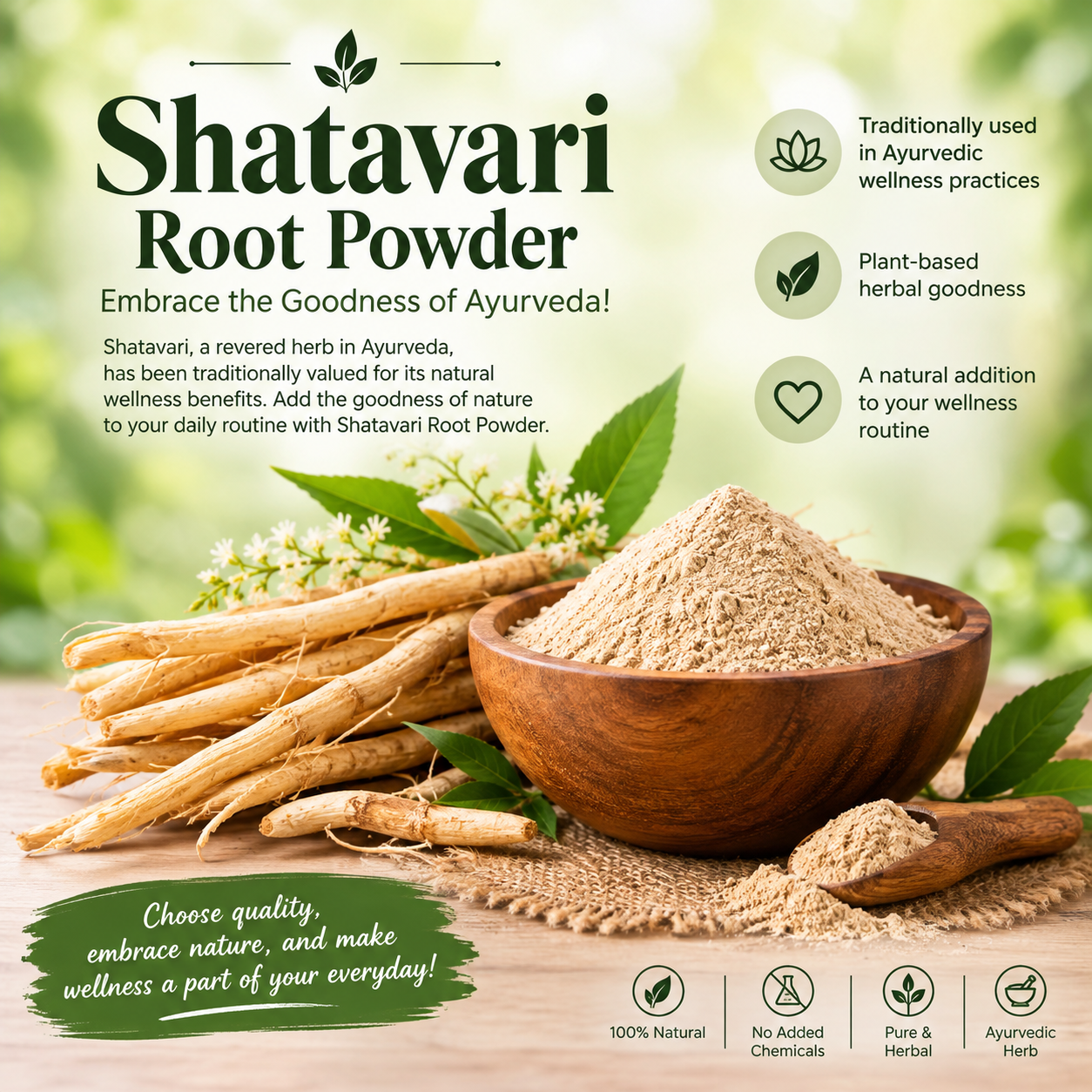
Shatavari, or Asparagus racemosus in scientific terms, is a traditional Ayurvedic herb that has been prized in India for centuries. While the common edible asparagus (Asparagus officinalis) is a different species, in herbal preparations it is Shatavari whose roots have been used traditionally. They are available as a powder, decoction, or extract from the dried roots.
The rising popularity of plant-based wellness today has brought increased attention to shatavari root powder benefits, its traditional uses, its nutritional profile, and responsible ways to select and use this botanical ingredient.
Shatavari is especially associated with traditional women’s wellness, digestive support, nourishment, and general vitality. Scientific research has also examined its phytochemicals and possible biological activities, but the evidence is stronger for some areas than others, and many traditional claims require more clinical research.
What Is Shatavari Root Powder?
Shatavari is a climbing plant from the Asparagus genus. The botanical name of this plant is Asparagus racemosus. The plant produces tuberous roots, which are traditionally dried and powdered for use in Ayurveda.
The roots are rich in naturally occurring compounds and include steroidal saponins, which are known as shatavarins. Research has reported that shatavari roots contain shatavarin I–IV and other phytochemicals.
The ingredient commonly known as Shatavari root powder is produced after cleaning, drying,, and grinding the dried roots finely.
Quality of the powder can vary based on:
• The roots are from
• Management practices
• Stage of harvest
• Conditions of drying
• Method of grinding
• Storage
• Packaging
• Testing and quality assurance
Hence, while purchasing Shatavari root powder, consumers and businesses should bear in mind the product as well as the supplier.
Benefits & Uses of Shatavari Root Powder
When considering the benefits of shatavari root powder, it’s important to differentiate between traditional Ayurvedic uses and modern clinical data. Research in humans is still emerging, but Shatavari has been used traditionally for a long time.
1. Commonly used for women's wellness
One of the most well-known traditional uses of Shatavari is for women’s health. Ayurvedic texts have traditionally described Shatavari as a rejuvenative herb and women’s tonic.
Traditionally, it has been used in formulas related to women’s reproductive health, nutrition, and the various stages of a woman’s life.
Modern research has also started looking into Shatavari preparations in relation to menopausal symptoms. One randomized controlled trial with a formulation containing a Shatavari root extract reported improvements in several menopausal symptoms, but the authors noted that larger and longer studies are needed.
2. Customarily Linked with Lactation
It is also used traditionally as a galactagogue to help support milk production during lactation. Shatavari has been traditionally used in Ayurvedic practice as a galactagogue.
But the evidence is not consistent. According to LactMed, clinical studies have not had consistent results, but some controlled studies have shown increased milk production. It also highlights that herbal galactagogues should not replace professional assessment of breastfeeding or milk supply issues.
Therefore, this traditional use should be used with caution, especially during pregnancy and breastfeeding.
3. Classic use of digestion
Shatavari root has traditionally been used for digestive problems, such as indigestion and some gastric conditions. Historically, the root has been used in Ayurvedic applications in preparations related to stomach and gastrointestinal wellness.
Some older research has investigated the effects of Shatavari root preparations on the health of the gastric system. Still, these findings should not be taken as evidence that regular Shatavari powder is a treatment for ulcers or other medical conditions.
4. Contains Natural Saponins
From a nutritional and botanical perspective, one of the important shatavari root powder benefits is its naturally occurring phytochemical profile.
Shatavari roots contain steroidal saponins such as shatavarins. These compounds have been identified in research as some of the characteristic constituents of Asparagus racemosus.
The concentration of these compounds can vary with plant material, cultivation, processing method, and whether the product is whole root powder or a standardized extract.
5. Classical Rejuvenating Herb
In Ayurvedic texts, Shatavari is called a Rasayana, a group of substances that have traditionally been associated with nourishment, rejuvenation, vitality, and healthy aging.
This time-honored positioning helps to account for why Shatavari continues to be a mainstay of herbal wellness formulations.
But words such as ‘rejuvenating’ or ‘strengthening’ refer to time-honored notions, not demonstrated medical outcomes. Consumers should not be led to believe that traditional use equates to a particular health benefit.
Nutritional and Phytochemical Composition of Shatavari
To understand Shatavari root powder nutrition, it is helpful to know that it is primarily valued as a botanical ingredient, not a conventional food source.
Research on the root has identified carbohydrates, fiber, protein, oils, minerals, and a variety of phytochemicals. One published analysis of the powdered roots included the carbohydrate, crude fiber, protein, oil, inorganic matter, and saponins, but the nutritional composition may vary widely from sample to sample.
Important naturally occurring constituents reported in Shatavari are:
• Stearic saponins
• Shatavarins
• Complex carbohydrates
• Flavonoids
• Polyphenol compounds
• Mucilage
• Other plant compounds
Because the composition is variable, one should not assume that a standardized extract has the same concentration or properties as ordinary root powder.
Shatavari Root Powder vs Shatavari Extract
This is important to remember when researching shatavari root powder benefits.
Shatavari root powder is usually prepared by drying and grinding the root. It keeps the plant material intact rather than concentrating on any one group of constituents.
The extract is further processed to isolate specific compounds. So an extract can have a higher concentration of some constituents than whole root powder, depending on the extraction process.
The form of herbal products for daily use depends upon the application. Standardized extracts may be preferred for research or formulations where reproducibility is especially important, as the concentrations of constituents can be more clearly defined.
How to Use Shatavari Root Powder?
Uses, traditional and modern, may vary with the product and formulation.
Herbal Products
Traditionally, the Shatavari root has been used in Ayurvedic preparations, either in powdered form or in preparations made with milk or other traditional carriers.
Healthy Drinks
Some people make drinks by mixing in botanical powders. Follow the instructions or directions of a qualified healthcare professional regarding the correct serving size and method.
Herbal Supplements
Shatavari powder or extract might be used by manufacturers as an ingredient in herbal products targeted for women's wellness or general nutritional support.
Ayurvedic Product
Shatavari continues to be a popular ingredient in traditional Ayurvedic formulations. Many traditional Ayurvedic preparations have now incorporated it, says a recent review.
How to Choose Quality Shatavari Root Powder
When buying Shatavari powder, especially in larger quantities, quality is key.
Botanical Identity Testing
Asparagus racemosus is clearly identified in the product. This allows to differentiate Shatavari from other species within the genus Asparagus.
Check the Plant Part.
Seek out products that are specifically made from the root. The root powder and extracts must be clearly identified on the product label.
Ask About Testing
Reliable suppliers should have quality-control procedures in place. Testing can include microbial parameters, heavy metals, pesticides, moisture, identity, and other specifications depending on the intended use.
Review Processing
Inquire about the cleaning, drying, grinding, and bagging of the roots. Excessive moisture, improper storage, or poor handling can affect the quality of botanical powders.
Search Traceability
A good supplier should be able to tell you about the source of products and how to identify each batch.
This is particularly important for businesses that buy Shatavari as a raw material for commercial products.
Shatavari Root Powder for Bulk & Commercial Use
When buying Shatavari powder, businesses should not just look at the price per kilo.
Key points to consider include
• Latin name
• Quality of the root
• Processing technique
• Testing documentation
• Batch Consistency
• Package
• MOQ
• Production capability
• Lead time
• Certifications if applicable
• Export or domestic needs
If you are comparing suppliers, always ask for a sample before you place a large order so you can check color, aroma, texture, particle size, and other product specifications.
A supplier with uniform documentation and batch quality may be a more beneficial long-term procurement partner than a supplier who is selected based only on price.
Safe and Responsible Use
Shatavari is a traditional botanical, but natural products are not automatically free of risk. Herbal products can vary in their composition and may interact with medicines or not be appropriate for some people. In general, NCCIH recommends that you talk with your health care professional before using a complementary health product, especially if you are taking medications or have a health condition.
If you are pregnant, nursing, taking any prescription medication, or have a hormone-sensitive or other medical condition, please consult with a healthcare professional before using Shatavari.
Of course, traditional claims are not to be used in place of medical diagnosis or treatment.
Why Shatavari Still Intrigues
Shatavari’s continuing popularity is a combination of traditional history and growing scientific interest.
Ayurveda has a long tradition; unique root phytochemicals and emerging clinical research make it an interesting botanical ingredient for modern wellness products. Current research is still looking at its possible biological activities, including those of its steroidal saponins.
In the meantime, more high-quality clinical research is needed before many traditional claims can be considered firmly established.
Husband-wife farms may be seen as part of the supplier-evaluation process for companies seeking to source botanical ingredients. Buyers should confirm botanical identity, root specifications, testing, packaging, and intended use prior to purchase.
Closing Remarks
The benefits of shatavari root powder most commonly discussed today are closely linked to its long history in Ayurveda and the increasing scientific research into its phytochemical makeup and potential applications.
Traditionally, Shatavari has been associated with women’s wellness, lactation support, digestive health, nourishment, and rejuvenation. Some of these areas have been studied, but evidence varies with the specific preparation, and traditional uses should not be assumed to represent clinically proven benefits.
For consumers and business owners alike, choosing a quality product is of equal importance. Look for clear botanical identification, ingredients that specifically identify roots, proper testing, transparent sourcing, and dependable packaging.
Whether you are looking at Shatavari for traditional wellness or sourcing it as a botanical ingredient, an informed approach can help you to select a product that meets your quality and application requirements.
Most Common Questions
1. What are the benefits of shatavari root powder?
Often-cited benefits of shatavari root powder are largely based on traditional Ayurvedic use and include support for women’s wellness, nourishment, digestive health, and lactation. These applications are being investigated in contemporary research. Certain preparations of cannabis or its derivatives have been approved for medical use in some conditions.
2. What is Shatavari Root Powder made of?
Generally, Shatavari root powder is prepared by drying and grinding Asparagus racemosus roots. It is not similar to the common vegetable, edible asparagus.
3. What Nutrients Are in Shatavari?
Shatavari roots are rich in carbohydrates, fiber, protein, minerals, and naturally occurring phytochemicals. Other research has found steroidal saponins like shatavarins. Exact compositions may differ depending on the raw materials and the methods of processing.
4. Is Shatavari traditionally used for the health of women?
Yes. Shatavari has a long history in Ayurvedic traditions as a women’s wellness herb and has traditionally been associated with reproductive and lactation-related applications. Such applications are still being evaluated in modern clinical research.
5. Is Shatavari root powder different from Shatavari extract?
No. Root powder is just dried root that has been ground up. An extract is made by an extraction process that may concentrate certain constituents. Therefore, their make-up and strength can differ.
6. What to look for when buying Shatavari root powder?
Examine the botanical name, plant part used, source, processing method, testing documentation, batch information, packaging, and supplier reputation. If you are buying for commercial use, ask for a sample and the relevant quality papers before ordering in bulk.